| https:///weradocs/Wera_Beamforming.shtml |
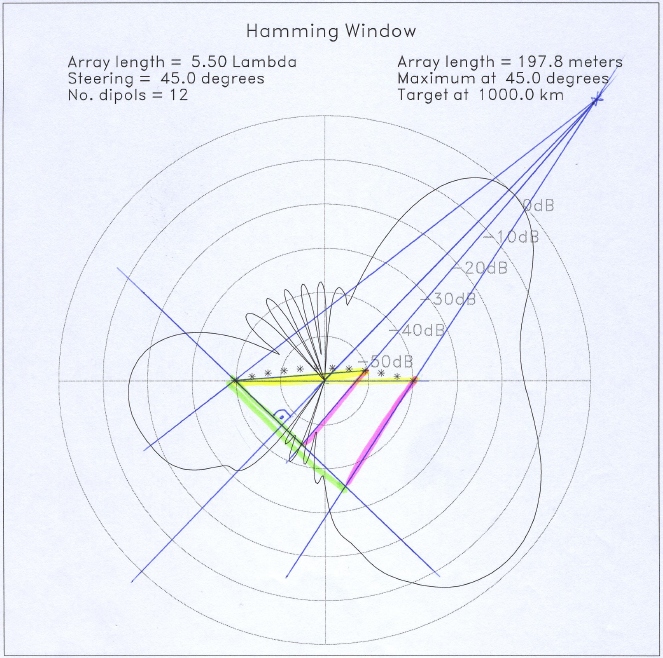
There are two windowing functions available to reduce the side lobes: A Hamming window and an Ultra Spherical window. In some cases, especially at long arrays (16 antennas and more), the Ultra Spherical window results in a better side lobe reduction. In other cases the Hamming window offers the better results. To apply the windowing function, the antenna spacing calculated from the projection of the array in direction to the "virtual target" is used for the Hamming window, e.g. the spacing which can be seen when looking from the "virtual target" to the array. The Ultra Spherical window is currently based on a constant antenna spacing, which has disadvantages is case of unequal antenna spacing and curved arrays.
Antenna sensitivity patterns have been calculated for typical situations. Note that this is the pattern of the receiving antenna array in case of a constant sensitivity of the single antennas, i.e. a circular pattern, and that no coupling between the antennas has been taken into account. Also, the effective antenna pattern of the total system is the product of the receive antenna pattern shown here and the transmit antenna pattern. The antenna patterns for some cases are cataloged here:
| 16 antenna linear array |
| 12 antenna linear array |
| 8 antenna linear array |
| 16 antenna curved array |
| 12 antenna curved array |
The antenna location file name for the sites is defined in Params.cfg . The antenna locations are given in geographical degrees (look here for the data format).
The antenna window selection for the sites (Hamming / Ultra Spherical) is defined in Params.cfg . The default antenna window is Ultra Spherical.